


Showing posts with label Farrah Fawcett. Show all posts
Showing posts with label Farrah Fawcett. Show all posts
Friday, October 15, 2010
Wednesday, July 15, 2009
The Burning Bed
Any man who puts his hand on a woman, especially in front of his children is a piece of shit.
Farrah Fawcett showed the horror of being a mother who regularly gets beaten by her husband, with no one to turn to for help, in "The Burning Bed" .
Today there are resources for women who are being abused - hotlines, shelters, support groups, the police.
The National Domestic Violence Hotline is 1-800-799-SAFE (7233) or 1-800-787-3224 (TTY) –This is a crisis intervention and referral phone line for domestic violence.


The Burning Bed is a non-fiction book by Faith McNulty about battered Dansville, Michigan housewife, Francine Hughes. After thirteen years of domestic abuse at the hands of her husband James Berlin ("Mickey") Hughes, she set fire to the bed he was sleeping in on March 9, 1977. James Hughes was killed and the house destroyed in the resulting inferno.
On the night of the fire, Hughes told her children to put their coats on and wait for her in the car. She then started the fire with gasoline poured around the bed Mickey Hughes was sleeping in. After the house had caught fire, Hughes drove with her three children to the local police station in order to confess.
Hughes was tried in Lansing and found by a jury of her peers to be not guilty by reason of insanity.
Having turned the book into a made-for-television movie, McNulty's screenplay, "The Burning Bed" premiered on NBC on October 8, 1984. The movie, directed by Robert Greenwald, starred Farrah Fawcett as Francine Hughes and Paul LeMat as Mickey Hughes.
It is not always easy to recognize abuse, even for victims themselves.
If you are not sure, you might be abused if:
• Your partner does things that make you afraid.
• Your partner does things to control you.
• Your partner threatens to hurt you.
• Your partner physically abuses you.
Remember:
• You are not alone.
• You are not to blame.
• You do not deserve to be abused.
• There is help available.
Domestic Violence and Abusive Relationships
Are you ever afraid of your partner?
Does your partner threaten to hurt you?
Does your partner control all the money?
Has your partner ever pushed you or shoved you, thrown things at you, or forced you to have sex?
Does your partner stalk you and show up uninvited at your job or when you’re out with friends?
If these experiences are part of your life, you are not alone and help is available in your community. If you are in New York City and are being abused by your partner, Safe Horizon can help you. Safe Horizon is the largest provider of domestic violence services in the country. Their counselors are compassionate and experienced, and our goal is to ensure that you and your children are safe. They understand how painful it is to live with abuse and how difficult it can be to talk about your situation. You might feel hopeless, desperate, confused, and alone. You may not want to tell people about your situation because you feel afraid, ashamed, or embarrassed. If you are in immediate danger, call 911.
Spousal abuse and battery are used for one purpose: to gain and maintain total control over the victim. In addition to physical violence, abusers use the following tactics to exert power over their wives or partners:
Dominance — Abusive individuals need to feel in charge of the relationship. They will make decisions for you and the family, tell you what to do, and expect you to obey without question. Your abuser may treat you like a servant, child, or even as his possession.
Humiliation — An abuser will do everything he can to make you feel bad about yourself, or defective in some way. After all, if you believe you're worthless and that no one else will want you, you're less likely to leave. Insults, name-calling, shaming, and public put-downs are all weapons of abuse designed to erode your self-esteem and make you feel powerless.
Isolation — In order to increase your dependence on him, an abusive partner will cut you off from the outside world. He may keep you from seeing family or friends, or even prevent you from going to work or school. You may have to ask permission to do anything, go anywhere, or see anyone. Source: Domestic Abuse Intervention Project, MN
Threats — Abusers commonly use threats to keep their victims from leaving or to scare them into dropping charges. Your abuser may threaten to hurt or kill you, your children, other family members, or even pets. He may also threaten to commit suicide, file false charges against you, or report you to child services.
Intimidation — Your abuser may use a variety of intimation tactics designed to scare you into submission. Such tactics include making threatening looks or gestures, smashing things in front of you, destroying property, hurting your pets, or putting weapons on display. The clear message is that if you don't obey, there will be violent consequences.
Denial and blame — Abusers are very good at making excuses for the inexcusable. They will blame their abusive and violent behavior on a bad childhood, a bad day, and even on the victims of their abuse. Your abuser may minimize the abuse or deny that it occurred. He will commonly shift the responsibility onto you: Somehow, his violence and abuse is your fault.
Domestic abuse falls into a common pattern, or cycle of violence:
Abuse — The abuser lashes out with aggressive or violent behavior. The abuse is a power play designed to show the victim "who is boss."
Guilt — After the abusive episode, the abuser feels guilt, but not over what he's done to the victim. The guilt is over the possibility of being caught and facing consequences.
Rationalization or excuses — The abuser rationalizes what he's done. He may come up with a string of excuses or blame the victim for his own abusive behavior—anything to shift responsibility from himself.
"Normal" behavior — The abuser does everything he can to regain control and keep the victim in the relationship. He may act as if nothing has happened, or he may turn on the charm. This peaceful honeymoon phase may give the victim hope that the abuser has really changed this time.
Fantasy and planning — The abuser begins to fantasize about abusing his victim again, spending a lot of time thinking about what she's done wrong and how he'll make her pay. Then he makes a plan for turning the fantasy of abuse into reality.
Set-up — The abuser sets up the victim and puts his plan in motion, creating a situation where he can justify abusing her.
The Full Cycle of Domestic Violence:
A man abuses his partner. After he hits her, he experiences self-directed guilt. He says, "I'm sorry for hurting you." What he does not say is, "Because I might get caught." He then rationalizes his behavior by saying that his partner is having an affair with someone. He tells her "If you weren't such a worthless whore I wouldn't have to hit you." He then acts contrite, reassuring her that he will not hurt her again. He then fantasizes and reflects on past abuse and how he will hurt her again. He plans on telling her to go to the store to get some groceries. What he withholds from her is that she has a certain amount of time to do the shopping. When she is held up in traffic and is a few minutes late, he feels completely justified in assaulting her because "you're having an affair with the store clerk." He has just set her up.
Your abuser’s apologies and loving gestures in between the episodes of abuse can make it difficult to leave. He may make you believe that you are the only person who can help him, that things will be different this time, and that he truly loves you. However, the dangers of staying are real.
Domestic abuse often escalates from threats and verbal abuse to physical violence and even murder. And while physical injury may be the most obvious danger, the emotional and psychological consequences of domestic abuse are also severe. No one deserves this kind of pain—and your first step to breaking free is recognizing that your situation is abusive. Once you acknowledge the reality of the abusive situation, then you can get the help you need.
Your abuser’s apologies and loving gestures in between the episodes of abuse can make it difficult to leave. He may make you believe that you are the only person who can help him, that things will be different this time, and that he truly loves you. However, the dangers of staying are real.
Domestic abuse often escalates from threats and verbal abuse to physical violence and even murder. And while physical injury may be the most obvious danger, the emotional and psychological consequences of domestic abuse are also severe. No one deserves this kind of pain—and your first step to breaking free is recognizing that your situation is abusive. Once you acknowledge the reality of the abusive situation, then you can get the help you need.
What is Domestic Violence?
Domestic violence, sometimes called battering, relationship abuse, or intimate partner violence, is a pattern of behavior used to establish power and control over another person through fear and intimidation, often including the threat or use of violence. Domestic violence is a crime that can include physical abuse, emotional abuse, economic abuse, and sexual abuse. Batterers use threats, intimidation, isolation, and other behaviors to maintain power over their victims. Domestic violence impacts everyone, regardless of income, race, ethnicity, sexual orientation, or religion. Thirty percent of Americans say they know a woman who has been physically abused by her husband or boyfriend in the past year (Lieberman Research, Inc., Tracking Survey conducted for The Advertising Council and the Family Violence Prevention Fund, July-October 1996). Domestic violence also affects same-sex relationships and men as victims.
If you are being abused, call the hotline 24 hours a day, 7 days a week.
It's impossible to know with certainty what goes on behind closed doors, but there are some telltale signs and symptoms of domestic violence and abuse. If you witness a number of warning signs in a friend, family member, or co-worker, you can reasonably suspect domestic abuse.
Warning Signs to look for:
Safe Horizon Hotlines
You can call Safe Horizon’s hotlines 24 hours a day, 7 days a week. The calls are free, and counselors are able to help you no matter what language you speak. Counselors provide crisis counseling, safety planning, assistance with finding shelter, referrals to Safe Horizon programs or other organizations, advocacy with the police, and other crucial services.
Safe Horizon’s Domestic Violence Hotline:800.621.HOPE (4673)
Safe Horizon’s Crime Victims Hotline:866.689.HELP (4357)
Safe Horizon’s Rape, Sexual Assault & Incest Hotline:212.227.3000
TDD phone number for all hotlines:866.604.5350
Farrah Fawcett showed the horror of being a mother who regularly gets beaten by her husband, with no one to turn to for help, in "The Burning Bed" .
Today there are resources for women who are being abused - hotlines, shelters, support groups, the police.
The National Domestic Violence Hotline is 1-800-799-SAFE (7233) or 1-800-787-3224 (TTY) –This is a crisis intervention and referral phone line for domestic violence.


The Burning Bed is a non-fiction book by Faith McNulty about battered Dansville, Michigan housewife, Francine Hughes. After thirteen years of domestic abuse at the hands of her husband James Berlin ("Mickey") Hughes, she set fire to the bed he was sleeping in on March 9, 1977. James Hughes was killed and the house destroyed in the resulting inferno.
On the night of the fire, Hughes told her children to put their coats on and wait for her in the car. She then started the fire with gasoline poured around the bed Mickey Hughes was sleeping in. After the house had caught fire, Hughes drove with her three children to the local police station in order to confess.
Hughes was tried in Lansing and found by a jury of her peers to be not guilty by reason of insanity.
Having turned the book into a made-for-television movie, McNulty's screenplay, "The Burning Bed" premiered on NBC on October 8, 1984. The movie, directed by Robert Greenwald, starred Farrah Fawcett as Francine Hughes and Paul LeMat as Mickey Hughes.
It is not always easy to recognize abuse, even for victims themselves.
If you are not sure, you might be abused if:
• Your partner does things that make you afraid.
• Your partner does things to control you.
• Your partner threatens to hurt you.
• Your partner physically abuses you.
Remember:
• You are not alone.
• You are not to blame.
• You do not deserve to be abused.
• There is help available.
Domestic Violence and Abusive Relationships
Are you ever afraid of your partner?
Does your partner threaten to hurt you?
Does your partner control all the money?
Has your partner ever pushed you or shoved you, thrown things at you, or forced you to have sex?
Does your partner stalk you and show up uninvited at your job or when you’re out with friends?
If these experiences are part of your life, you are not alone and help is available in your community. If you are in New York City and are being abused by your partner, Safe Horizon can help you. Safe Horizon is the largest provider of domestic violence services in the country. Their counselors are compassionate and experienced, and our goal is to ensure that you and your children are safe. They understand how painful it is to live with abuse and how difficult it can be to talk about your situation. You might feel hopeless, desperate, confused, and alone. You may not want to tell people about your situation because you feel afraid, ashamed, or embarrassed. If you are in immediate danger, call 911.
Spousal abuse and battery are used for one purpose: to gain and maintain total control over the victim. In addition to physical violence, abusers use the following tactics to exert power over their wives or partners:
Dominance — Abusive individuals need to feel in charge of the relationship. They will make decisions for you and the family, tell you what to do, and expect you to obey without question. Your abuser may treat you like a servant, child, or even as his possession.
Humiliation — An abuser will do everything he can to make you feel bad about yourself, or defective in some way. After all, if you believe you're worthless and that no one else will want you, you're less likely to leave. Insults, name-calling, shaming, and public put-downs are all weapons of abuse designed to erode your self-esteem and make you feel powerless.
Isolation — In order to increase your dependence on him, an abusive partner will cut you off from the outside world. He may keep you from seeing family or friends, or even prevent you from going to work or school. You may have to ask permission to do anything, go anywhere, or see anyone. Source: Domestic Abuse Intervention Project, MN
Threats — Abusers commonly use threats to keep their victims from leaving or to scare them into dropping charges. Your abuser may threaten to hurt or kill you, your children, other family members, or even pets. He may also threaten to commit suicide, file false charges against you, or report you to child services.
Intimidation — Your abuser may use a variety of intimation tactics designed to scare you into submission. Such tactics include making threatening looks or gestures, smashing things in front of you, destroying property, hurting your pets, or putting weapons on display. The clear message is that if you don't obey, there will be violent consequences.
Denial and blame — Abusers are very good at making excuses for the inexcusable. They will blame their abusive and violent behavior on a bad childhood, a bad day, and even on the victims of their abuse. Your abuser may minimize the abuse or deny that it occurred. He will commonly shift the responsibility onto you: Somehow, his violence and abuse is your fault.
Domestic abuse falls into a common pattern, or cycle of violence:
Abuse — The abuser lashes out with aggressive or violent behavior. The abuse is a power play designed to show the victim "who is boss."
Guilt — After the abusive episode, the abuser feels guilt, but not over what he's done to the victim. The guilt is over the possibility of being caught and facing consequences.
Rationalization or excuses — The abuser rationalizes what he's done. He may come up with a string of excuses or blame the victim for his own abusive behavior—anything to shift responsibility from himself.
"Normal" behavior — The abuser does everything he can to regain control and keep the victim in the relationship. He may act as if nothing has happened, or he may turn on the charm. This peaceful honeymoon phase may give the victim hope that the abuser has really changed this time.
Fantasy and planning — The abuser begins to fantasize about abusing his victim again, spending a lot of time thinking about what she's done wrong and how he'll make her pay. Then he makes a plan for turning the fantasy of abuse into reality.
Set-up — The abuser sets up the victim and puts his plan in motion, creating a situation where he can justify abusing her.
The Full Cycle of Domestic Violence:
A man abuses his partner. After he hits her, he experiences self-directed guilt. He says, "I'm sorry for hurting you." What he does not say is, "Because I might get caught." He then rationalizes his behavior by saying that his partner is having an affair with someone. He tells her "If you weren't such a worthless whore I wouldn't have to hit you." He then acts contrite, reassuring her that he will not hurt her again. He then fantasizes and reflects on past abuse and how he will hurt her again. He plans on telling her to go to the store to get some groceries. What he withholds from her is that she has a certain amount of time to do the shopping. When she is held up in traffic and is a few minutes late, he feels completely justified in assaulting her because "you're having an affair with the store clerk." He has just set her up.
Your abuser’s apologies and loving gestures in between the episodes of abuse can make it difficult to leave. He may make you believe that you are the only person who can help him, that things will be different this time, and that he truly loves you. However, the dangers of staying are real.
Domestic abuse often escalates from threats and verbal abuse to physical violence and even murder. And while physical injury may be the most obvious danger, the emotional and psychological consequences of domestic abuse are also severe. No one deserves this kind of pain—and your first step to breaking free is recognizing that your situation is abusive. Once you acknowledge the reality of the abusive situation, then you can get the help you need.
Your abuser’s apologies and loving gestures in between the episodes of abuse can make it difficult to leave. He may make you believe that you are the only person who can help him, that things will be different this time, and that he truly loves you. However, the dangers of staying are real.
Domestic abuse often escalates from threats and verbal abuse to physical violence and even murder. And while physical injury may be the most obvious danger, the emotional and psychological consequences of domestic abuse are also severe. No one deserves this kind of pain—and your first step to breaking free is recognizing that your situation is abusive. Once you acknowledge the reality of the abusive situation, then you can get the help you need.
What is Domestic Violence?
Domestic violence, sometimes called battering, relationship abuse, or intimate partner violence, is a pattern of behavior used to establish power and control over another person through fear and intimidation, often including the threat or use of violence. Domestic violence is a crime that can include physical abuse, emotional abuse, economic abuse, and sexual abuse. Batterers use threats, intimidation, isolation, and other behaviors to maintain power over their victims. Domestic violence impacts everyone, regardless of income, race, ethnicity, sexual orientation, or religion. Thirty percent of Americans say they know a woman who has been physically abused by her husband or boyfriend in the past year (Lieberman Research, Inc., Tracking Survey conducted for The Advertising Council and the Family Violence Prevention Fund, July-October 1996). Domestic violence also affects same-sex relationships and men as victims.
If you are being abused, call the hotline 24 hours a day, 7 days a week.
It's impossible to know with certainty what goes on behind closed doors, but there are some telltale signs and symptoms of domestic violence and abuse. If you witness a number of warning signs in a friend, family member, or co-worker, you can reasonably suspect domestic abuse.
Warning Signs to look for:
- Frequent injuries, with the excuse of “accidents”
- Frequent and sudden absences from work or school
- Frequent, harassing phone calls from the partner
- Fear of the partner, references to the partner's anger
- Personality changes (e.g. an outgoing woman becomes withdrawn)
- Excessive fear of conflict
- Submissive behavior, lack of assertiveness
- Isolation from friends and family
- Insufficient resources to live (money, credit cards, car)
- Depression, crying, low self-esteem
Safe Horizon Hotlines
You can call Safe Horizon’s hotlines 24 hours a day, 7 days a week. The calls are free, and counselors are able to help you no matter what language you speak. Counselors provide crisis counseling, safety planning, assistance with finding shelter, referrals to Safe Horizon programs or other organizations, advocacy with the police, and other crucial services.
Safe Horizon’s Domestic Violence Hotline:800.621.HOPE (4673)
Safe Horizon’s Crime Victims Hotline:866.689.HELP (4357)
Safe Horizon’s Rape, Sexual Assault & Incest Hotline:212.227.3000
TDD phone number for all hotlines:866.604.5350
Thursday, June 25, 2009
Farrah Fawcett RIP
American Vogue July 1978 Cover

Photographer: Patrick Demarchelier
Makeup: Way Bandy
Hair: Garren
Fashion: Yves Saint Laurent Haute Couture
Farrah Fawcett's death has touched me deeply. She was an American icon and a real beauty. Her warm smile and positive energy brought me a lot of happiness. Farrah was sick for a long time, and is no longer in pain. She is in a better place, and will be missed.
I can't believe I am crying at work....again. Her struggle with cancer, and passing remind me that life is not to be taken for granted. Live each day as if it is your last. Farrah Fawcett was 62 years old, the same age as my father. My father is a great man, and means the world to me. My heart goes out to Farrah, her father, Ryan O'Neal, her son, and everyone who was lucky enough to be loved by her.
Farrah's friends remember her:
In a statement confirming the tragic news, Ryan O'Neal says: "After a long and brave battle with cancer, our beloved Farrah has passed away. Although this is an extremely difficult time for her family and friends, we take comfort in the beautiful times that we shared with Farrah over the years and the knowledge that her life brought joy to so many people around the world."
He reveals Fawcett was awake and aware of her surroundings shortly before her death, telling People.com, "She now belongs to the angels. She's now with her mother and sister and her God. I loved her with all my heart. I will miss her so very, very much. She was in and out of consciousness. I talked to her all through the night. I told her how very much I loved her. She's in a better place now.
Fawcett's Charlie's Angels co-stars Jaclyn Smith, Kate Jackson and the actress who replaced her on the hit show, Cheryl Ladd, were among the first celebrities to remember the star. Smith commented, "She had courage and strength... Now she has peace as she rests with real angels." And Ladd told HollyScoop.com, "I'm terribly sad about Farrah's passing. She was incredibly brave, and God will be welcoming her with open arms."
"I will miss Farrah every day," commented Kate Jackson to PEOPLE. "She was a selfless person who loved her family and friends with all her heart, and what a big heart it was. Farrah showed immense courage and grace throughout her illness and was an inspiration to those around her. When I think of Farrah I will remember her kindness, her cutting dry wit and, of course, her beautiful smile."
Added Jackson, "Today when you think of Farrah remember her smiling, because that is exactly how she wanted to be remembered."
Playboy publisher Hugh Hefner called Fawcett, who died of cancer at age 62 Thursday morning, the "Marilyn Monroe of the 1970s" whose famous poster "defined what one thinks of as the All-American girl."
"Men fell in love with her and women wanted to look like her," says Hefner of his magazine's cover model. "She had a magic that never went away. She became a part of the pop culture.
Griffin O'Neal, son of Ryan, said, "I never looked at her as a 'star,' or a 'Charlie's Angel.' I looked at her always as this wonderful Southern Belle, a lady. I was fascinated by her. I loved her. She was the most gracious, wonderful person. I always wondered why she was around this family. 'Why are you here?' She was such a beautiful person. Especially in the latter days."
He went on to say, "It was incredible watching her battling to help [her son] Redmond. She had the patience of a giant. I'm so worried about my brother. What's he going to do without her? Farrah was part of my family. My heart is broken. I will miss her forever and ever. She was so kind and gracious."
Fawcett's former husband, Lee Majors, says, "She fought a tremendous battle against a terrible disease. She was an angel on earth and now an angel forever."
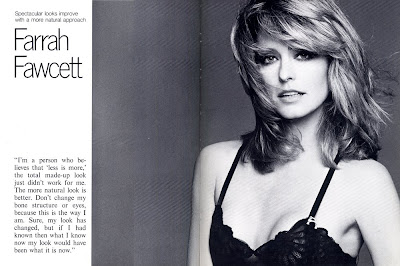
Hairstylist Jose Eber, who created Fawcett's famous blonde mane, says, "She was blessed with the most amazing hair anybody could have."
"Her hair had its own personality," he says. "In my business, doing hair for so long now, very rarely do you see a person who has hair with such perfection. And it was all natural."
Farrah Fawcett, Photo Francesco Scavullo

Farrah Fawcett, Photo: Francesco Scavullo
Charlie's Angel theme:
My favorite Charlie's Angels episode was "Angels in Chains". A chambray shirt & a high waisted denim jean is a classic look:
Photographer: Patrick Demarchelier
Makeup: Way Bandy
Hair: Garren
Fashion: Yves Saint Laurent Haute Couture
Farrah Fawcett's death has touched me deeply. She was an American icon and a real beauty. Her warm smile and positive energy brought me a lot of happiness. Farrah was sick for a long time, and is no longer in pain. She is in a better place, and will be missed.
I can't believe I am crying at work....again. Her struggle with cancer, and passing remind me that life is not to be taken for granted. Live each day as if it is your last. Farrah Fawcett was 62 years old, the same age as my father. My father is a great man, and means the world to me. My heart goes out to Farrah, her father, Ryan O'Neal, her son, and everyone who was lucky enough to be loved by her.
Farrah's friends remember her:
In a statement confirming the tragic news, Ryan O'Neal says: "After a long and brave battle with cancer, our beloved Farrah has passed away. Although this is an extremely difficult time for her family and friends, we take comfort in the beautiful times that we shared with Farrah over the years and the knowledge that her life brought joy to so many people around the world."
He reveals Fawcett was awake and aware of her surroundings shortly before her death, telling People.com, "She now belongs to the angels. She's now with her mother and sister and her God. I loved her with all my heart. I will miss her so very, very much. She was in and out of consciousness. I talked to her all through the night. I told her how very much I loved her. She's in a better place now.
Fawcett's Charlie's Angels co-stars Jaclyn Smith, Kate Jackson and the actress who replaced her on the hit show, Cheryl Ladd, were among the first celebrities to remember the star. Smith commented, "She had courage and strength... Now she has peace as she rests with real angels." And Ladd told HollyScoop.com, "I'm terribly sad about Farrah's passing. She was incredibly brave, and God will be welcoming her with open arms."
"I will miss Farrah every day," commented Kate Jackson to PEOPLE. "She was a selfless person who loved her family and friends with all her heart, and what a big heart it was. Farrah showed immense courage and grace throughout her illness and was an inspiration to those around her. When I think of Farrah I will remember her kindness, her cutting dry wit and, of course, her beautiful smile."
Added Jackson, "Today when you think of Farrah remember her smiling, because that is exactly how she wanted to be remembered."
Playboy publisher Hugh Hefner called Fawcett, who died of cancer at age 62 Thursday morning, the "Marilyn Monroe of the 1970s" whose famous poster "defined what one thinks of as the All-American girl."
"Men fell in love with her and women wanted to look like her," says Hefner of his magazine's cover model. "She had a magic that never went away. She became a part of the pop culture.
Griffin O'Neal, son of Ryan, said, "I never looked at her as a 'star,' or a 'Charlie's Angel.' I looked at her always as this wonderful Southern Belle, a lady. I was fascinated by her. I loved her. She was the most gracious, wonderful person. I always wondered why she was around this family. 'Why are you here?' She was such a beautiful person. Especially in the latter days."
He went on to say, "It was incredible watching her battling to help [her son] Redmond. She had the patience of a giant. I'm so worried about my brother. What's he going to do without her? Farrah was part of my family. My heart is broken. I will miss her forever and ever. She was so kind and gracious."
Fawcett's former husband, Lee Majors, says, "She fought a tremendous battle against a terrible disease. She was an angel on earth and now an angel forever."
Hairstylist Jose Eber, who created Fawcett's famous blonde mane, says, "She was blessed with the most amazing hair anybody could have."
"Her hair had its own personality," he says. "In my business, doing hair for so long now, very rarely do you see a person who has hair with such perfection. And it was all natural."
Farrah Fawcett, Photo Francesco Scavullo
Farrah Fawcett, Photo: Francesco Scavullo
Charlie's Angel theme:
My favorite Charlie's Angels episode was "Angels in Chains". A chambray shirt & a high waisted denim jean is a classic look:
Subscribe to:
Posts (Atom)


