Showing posts with label Richard Avedon. Show all posts

Thursday, June 25, 2009

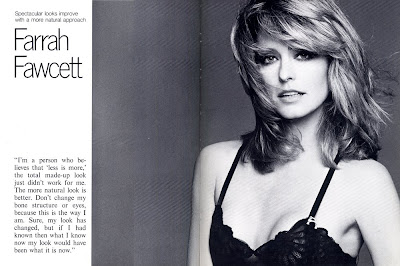
Farrah Fawcett RIP

American Vogue July 1978 Cover

Photographer: Patrick Demarchelier
Makeup: Way Bandy
Hair: Garren
Fashion: Yves Saint Laurent Haute Couture

Farrah Fawcett's death has touched me deeply. She was an American icon and a real beauty. Her warm smile and positive energy brought me a lot of happiness. Farrah was sick for a long time, and is no longer in pain. She is in a better place, and will be missed.

I can't believe I am crying at work....again. Her struggle with cancer, and passing remind me that life is not to be taken for granted. Live each day as if it is your last. Farrah Fawcett was 62 years old, the same age as my father. My father is a great man, and means the world to me. My heart goes out to Farrah, her father, Ryan O'Neal, her son, and everyone who was lucky enough to be loved by her.

Farrah's friends remember her:

In a statement confirming the tragic news, Ryan O'Neal says: "After a long and brave battle with cancer, our beloved Farrah has passed away. Although this is an extremely difficult time for her family and friends, we take comfort in the beautiful times that we shared with Farrah over the years and the knowledge that her life brought joy to so many people around the world."
He reveals Fawcett was awake and aware of her surroundings shortly before her death, telling People.com, "She now belongs to the angels. She's now with her mother and sister and her God. I loved her with all my heart. I will miss her so very, very much. She was in and out of consciousness. I talked to her all through the night. I told her how very much I loved her. She's in a better place now.

Fawcett's Charlie's Angels co-stars Jaclyn Smith, Kate Jackson and the actress who replaced her on the hit show, Cheryl Ladd, were among the first celebrities to remember the star. Smith commented, "She had courage and strength... Now she has peace as she rests with real angels." And Ladd told HollyScoop.com, "I'm terribly sad about Farrah's passing. She was incredibly brave, and God will be welcoming her with open arms."

"I will miss Farrah every day," commented Kate Jackson to PEOPLE. "She was a selfless person who loved her family and friends with all her heart, and what a big heart it was. Farrah showed immense courage and grace throughout her illness and was an inspiration to those around her. When I think of Farrah I will remember her kindness, her cutting dry wit and, of course, her beautiful smile."

Added Jackson, "Today when you think of Farrah remember her smiling, because that is exactly how she wanted to be remembered."

Playboy publisher Hugh Hefner called Fawcett, who died of cancer at age 62 Thursday morning, the "Marilyn Monroe of the 1970s" whose famous poster "defined what one thinks of as the All-American girl."

"Men fell in love with her and women wanted to look like her," says Hefner of his magazine's cover model. "She had a magic that never went away. She became a part of the pop culture.

Griffin O'Neal, son of Ryan, said, "I never looked at her as a 'star,' or a 'Charlie's Angel.' I looked at her always as this wonderful Southern Belle, a lady. I was fascinated by her. I loved her. She was the most gracious, wonderful person. I always wondered why she was around this family. 'Why are you here?' She was such a beautiful person. Especially in the latter days."

He went on to say, "It was incredible watching her battling to help [her son] Redmond. She had the patience of a giant. I'm so worried about my brother. What's he going to do without her? Farrah was part of my family. My heart is broken. I will miss her forever and ever. She was so kind and gracious."

Fawcett's former husband, Lee Majors, says, "She fought a tremendous battle against a terrible disease. She was an angel on earth and now an angel forever."

Hairstylist Jose Eber, who created Fawcett's famous blonde mane, says, "She was blessed with the most amazing hair anybody could have."

"Her hair had its own personality," he says. "In my business, doing hair for so long now, very rarely do you see a person who has hair with such perfection. And it was all natural."

Farrah Fawcett, Photo Francesco Scavullo


Farrah Fawcett, Photo: Francesco Scavullo

Charlie's Angel theme:


My favorite Charlie's Angels episode was "Angels in Chains". A chambray shirt & a high waisted denim jean is a classic look:


Tuesday, June 9, 2009

Oh L'amour! How Will I Know? Basically, I Wanna Dance With Numbers

A great man once said that creating a pop song that makes people happy is one of the hardest things to do.

It is quite simple to tap into negative energy and create the kind of songs and pictures that make you cry.

There is a sadness in this world, for we are ignorant of many things. Yes, we are ignorant of many beautiful things - things like the truth. So sadness, in our ignorance, is very real. Tears are real. What is this thing called a tear? There are even tiny ducts - tear ducts - to produce these tears should the sadness occur. Then the day when the sadness comes - then we ask: "Will this sadness which makes me cry - will this sadness that makes my heart cry out - will it ever end?" The answer, of course, is yes. One day the sadness will end.

Yesterday a friend suggested I listen to "Oh L'amour" on a rainy NYC day. That, and "How Will I Know" are two pop songs that have brought me happiness at different stages of my life.

Patrick Bateman: Did you know that Whitney Houston's debut LP, called simply Whitney Houston had 4 number one singles on it? Did you know that, Christie?

Elizabeth: [laughing] You actually listen to Whitney Houston? You own a Whitney Houston CD? More than one?

Patrick Bateman: It's hard to choose a favorite among so many great tracks, but "The Greatest Love of All" is one of the best, most powerful songs ever written about self-preservation, dignity. Its universal message crosses all boundaries and instills one with the hope that it's not too late to better ourselves. Since, Elizabeth, it's impossible in this world we live in to empathize with others, we can always empathize with ourselves. It's an important message, crucial really. And it's beautifully stated on the album.


"How Will I Know" is the third hit single from Whitney Houston's self-titled first album. The single was released in November 1985 and was written by George Merrill and Shannon Rubicam of Boy Meets Girl fame, who wrote it for Janet Jackson[1]. The song is an electric dance tune about the singer wondering if a guy she likes feels the same way about her.

On the US Billboard Hot 100 singles survey, "How Will I Know" rose from #60 to #50 the week of December 14, 1985, reaching the #1 spot by February 15, 1986, and becoming Houston's second number-one single. The single displaced "That's What Friends Are For" by Dionne Warwick, thus becoming only the third time (and first by female artists) in history for relatives to replace themselves at number one. It remained at number one for two weeks, and spent fifteen weeks in the top forty.

The music video for "How Will I Know" was directed by Brian Grant and is set against a fantasy, vividly colored background, with dancers in black outfits and wearing French-style makeup. The video is recognized for the animated paint dripping down the screen. In the video, when Houston sings "I'm asking you 'cause you know about these things", there's a brief screencap of singer, close family friend, and Godmother Aretha Franklin.

There's a boy I know
he's the one I dream of.
Looks into my eyes
takes me to the clouds above.
Oh
I lose control
can't seem to get enough.
When I wake from dreamin'
tell me
is it really love?

How will I know? Cirl
trust your feelings -
How will I know?
How will I know? Love can be deceivin' -
How will I know?

How will I know if he really loves me?
I say a prayer with every heartbeat.
I fall in love whenever we meet.
I'm asking you
'cause you know about these things.
How will I know if he's thinking of me?
I try to phone
but I'm too shy - can't speak.
Falling in love is so bitter sweet.
This love is strong
why do I feel weak?

Oh
wake me
I'm shakin'; wish I had you near me now.
Said there's no mistakin'
what I feel is really love.

Oh
tell me: how will I know? Girl
trust your feelings - . . .
How will I know if he really loves me? . . .

If he loves me - if he loves me not -
if he loves me - if he loves me not -
How will I know? - How will I know? -
How will I know? - How will I know

How will I know if he really loves me? . . .
How will I know? How will I know? How will I know?
How will I know? - I say a prayer - how will I know?
How will I know? - I fall in love - how will I know?
How will I know? - I'm asking you - how will I know?


"Oh L'amour" is a song by British synth pop duo Erasure,c onsisting of songwriter and keyboardist Vince Clarke and singer Andy Bell, released in April 1986 as their third single. Written by Erasure members Vince Clarke and Andy Bell, "Oh L'amour" is a lament from someone experiencing unrequited love ("broke my heart / now I'm aching for you"). The song is an uptempo synth pop dance track.

Oh l'amour
Broke my heart
Now I'm aching for you
Mon amour
Whats a boy in love
Supposed to do

Looking for you
You were looking for me
Always reaching for you
You were too blind to see
Oh love of my heart
Why leave me alone
I'm falling apart
No good on my own

Oh lamour
Broke my heart
Now I'm aching for you
Mon amour
Whats a boy in love
Supposed to do

Why throw it away
Why walk out on me
I just live for the day
For the way it should be
There once was a time
Had you here by my side
You said I wasnt your kind
Only here for the ride

Oh l'amour
Broke my heart
Now I'm aching for you
Mon amour
Whats a boy in love
Supposed to do

No emotional ties
You don't remember my name
I lay down and die
I'm only to blame
Oh love of my heart
Its up to you now
You tore me apart
I hurt inside-out

Oh lamour
Broke my heart
Now I'm aching for you
Mon amour
Whats a boy in love
Supposed to do

Oh l'amour
Broke my heart
Now I'm aching for you
Mon amour
Whats a boy in love
Supposed to do


Girls On Top was the pseudonym used by record producer Richard X between 2001 and 2002. As part of the bootleg music craze of the time, Girls On Top had a string of limited edition underground singles released on vinyl only. Richard X used the method of taking the instrumental music track of one pop record and the a cappella version of another pop record and splicing the two together.

"I Wanna Dance With Numbers" is Whitney Houston's "I Wanna Dance With Somebody (Who Loves Me)" vs Kraftwerk's "Numbers".

Uh... yeh... woo... hey yeh... huh... hoo yeh... uh huh... yeah...
I want to dance...

Clocks strikes upon the hour,
And the sun begins to fade.
Still enough time to figure out,
How to chase my blues away.
I've done alright up 'til now,
It's the light of day that shows me how,
And when the night falls, loneliness calls.

(Chorus:)
Oh! I wanna dance with somebody.
I wanna feel the heat with somebody.
Yeah! I wanna dance with somebody,
With somebody who loves me. (x2)

I've been in love and lost my senses,
Spinning through the town.
Sooner or later the fever ends,
And I wind up feeling down.
I need a man who'll take a chance,
On a love that burns hot enough to last.
So when the night falls,
My lonely heart calls.

(Chorus x2)

Somebody who... Somebody who... somebody who loves me...
Somebody who... Somebody who... to hold me in his arms...

I need a man who'll take a chance,
On a love that burns hot enough to last.
So when the night falls,
My lonely heart calls.

(Chorus x2)

Ooh ooh! Dance! Come on baby... (laughs)
Dance! Wooo! Yeh! Dance! You dance like this... (laughs)
Woah! (dance!)

Don't you wanna dance? (dance!) with me baby.
Don't you wanna dance? (dance!) with me boy.
Don't you wanna dance? (dance!) with me baby.
With somebody who loves me.

Don't you wanna dance?
Say you wanna dance.
Don't you wanna dance? (dance!)

Don't you wanna dance?
Say you wanna dance.
Don't you wanna dance? (dance!)

Don't you wanna dance?
Say you wanna dance. (uh huh)(dance!)
With somebody who loves me.
Ooh (dance!)
Ooh-oh (dance!)
Ooh (dance!)
...with me baby...

I Wanna Dance With Numbers

Thursday, May 14, 2009

Richard Avedon opening tonight at the International Center of Photography

Tonight I will be attending the opening of the Richard Avedon exhibition at the International Center of Photography.

Veruschka with Richard Avedon, dress by Kimberly, New York, January 1967


From the ICP:

Richard Avedon (1923–2004) revolutionized fashion photography starting in the post-World War II era and redefined the role of the fashion photographer. Anticipating many of the cultural cross-fertilizations that have occurred between high art, commercial art, fashion, advertising, and pop culture in the last twenty years, he created spirited, imaginative photographs that showed fashion and the modern woman in a new light. He shook up the chilly, static formulas of the fashion photograph and by 1950 was the most imitated American editorial photographer. Injecting a forthright, American energy into a business that had been dominated by Europeans, Avedon's stylistic innovations continue to influence photographers around the world.

This exhibition will be the most comprehensive exploration to date of Avedon's fashion photography during his long career at Harper's Bazaar, Vogue, The New Yorker, and beyond. Working closely with The Richard Avedon Foundation, ICP curator Carol Squiers and guest curator Vince Aletti will present new scholarship on the evolution and extraordinary, ongoing impact of his work. The exhibition will feature more than 200 works by Richard Avedon, spanning his entire career, and will include vintage prints, contact sheets, magazine layouts, and archival material.

Several Women models were fortunate enough to work with Richard Avedon, including Veruschka, Kylie Bax, Christina Kruse and Karen Elson.

Veruschka, dress by Kimberly,New York, January 1967


Veruschka, Photo: Richard Avedon


Kylie Bax


Kylie Bax


Kylie Bax


Kylie Bax


Christina Kruse


Christina Kruse


Karen Elson

Karen Elson


Karen Elson
How Avedon Blurred His Own Image

By CATHY HORYN
Published: May 13, 2009
ON a morning in April 1967, Twiggy, the doe-eyed British modeling sensation, sat on a stool before Richard Avedon in his studio on East 58th Street. She had on a plain black dress and black fishnets, and it was her first session with the fashion photographer. She was 17.
As Avedon stood behind a Rolleiflex camera mounted on a tripod, the Kinks blared from a phonograph nearby. Since he began photographing beautiful women in the mid-1940s — first for Harper’s Bazaar, then Vogue — Avedon made it a practice to ask his models what music and food they preferred. This more than contributed to the relaxed atmosphere of the studio. “They all wanted to please him,” said Polly Mellen, the Vogue editor on that shoot.
Bending over the Rolleiflex, Avedon said, “All right, now, very straight,” and Twiggy sat up straight and turned her gaze to the camera.

Despite the hullabaloo she caused, which the writer Thomas Whiteside described in a profile that year in The New Yorker, Twiggy’s career was actually brief. It is Avedon’s pictures that make us think of her as the definitive ’60s child.

His gift was not merely for the alive moment — the model, her chin up, leaping cleanly over a puddle. Rather, it was for knowing which of the myriad of gestures produced the truest sense of the moment. Whiteside found Avedon’s process utterly unique, explaining he “exercised meticulous control over his model, almost as though he were working from a blueprint.”
That blueprint is, broadly, the subject of a retrospective at the International Center of Photography, from May 15 to Sept. 6.

From his earliest, sun-splashed pictures in 1944 to portraits in 2000 that convey his fashion fatigue, the I.C.P. exhibition is the largest survey of Avedon’s fashion work since the Metropolitan Museum show in 1978.

In both appearance and personality, Avedon cut the ideal figure of a fashion photographer, and five years after his death, at age 81, he remains that. His photographic style has been widely imitated, not least by Steven Meisel. Generations of models have sprung across mid-tone seamless backdrops, or sat pensively in cafes, or pretended to be in love or quite alone — all because of Avedon. And yet if his images retain their special power, if the experiences and emotions they present seem lived and not merely imitated, it may be because he is the more complete photographer.

A twice-married man, whose energy and trim, compact looks seemed to embody the word “flair,” Avedon often harbored doubts about his next project, yet recovered quickly. His great passion, outside of picture-making and his family, was the theater. A friend, the writer Adam Gopnik, reckoned that Avedon saw Mandy Patinkin’s one-man show 35 times in the space of a summer. “He lived for performance,” Mr. Gopnik said.

It’s probable that as a teenager in New York in the early ’40s — Avedon dropped out of DeWitt Clinton High School and enlisted in the merchant marine, where he learned basic photography — he saw not so much the fashion in the streets as the cosmopolitan gestures that animated it. Movement entered his pictures for Harper’s Bazaar soon after he arrived there. Storytelling followed, especially once he began shooting the Paris collections and invented street scenes for models like Dovima and Dorian Leigh, or his first wife, Doe Avedon.

Already on the masthead at Bazaar was Martin Munkacsi, the Hungarian-born photographer whose action shots impressed Henri Cartier-Bresson, among others. In later years, when he discussed his beginnings, Avedon often made Munkacsi out to be a more distant figure than he was, according to the exhibition’s curators, Carol Squiers and Vince Aletti.

Then again, Avedon always maintained that in every picture he was photographing himself. When Ms. Squiers asked the photographer Lillian Bassman, who spent summers with Avedon and their families on Fire Island, why he had his models running — or laughing — she replied: “Did you ever meet Dick? He was always jumping around.”

Outdoor shots and innovative photography were part of the terrain at Bazaar in the ’40s and ’50s. The cultural life in New York similarly enriched the work of other photographers, notably Irving Penn, who was at Vogue and who would be Avedon’s friend and rival for the next 40 years. So what made Avedon different?

HE was keenly aware that beauty had an element of tragedy — it faded, for one thing, or it came at a terrible loss of self. Growing up, Avedon heard his mother say to his sister Louise, who would eventually die, at 42, in a mental institution, “You’re so beautiful you don’t have to open your mouth.” This notion that beauty can be intoxicating but, equally, impoverishing to the soul, Ms. Squiers said, tinged Avedon’s early pictures with a feeling of compassion.

And it may never have completely left him. A photograph he made in 1998 of a robotic-looking model wearing a mouth plug seemed to circle back to his sister. Such pictures, made when he was a staff photographer at The New Yorker, suggested Avedon’s long view of fashion, but also a distinct side of his personality. “There was a real sadness about him,” said Norma Stevens, who joined his studio in 1976 and today runs the Richard Avedon Foundation. “He loved working, and he would be up for that. But it was like a performance. After that there would be a drop.”
Drawn to theatrical performers, Avedon took numerous portraits when he was at Bazaar, and, like Penn, derived a lot of artistic satisfaction from them. Yet into the ’60s, influenced by the Civil Rights movement and the poets of the counterculture, the portraits acquired a hardness that made critics question Avedon’s right to be more than a fashion photographer. An eviscerating review in 1964 by Robert Brustein of “Nothing Personal,” the book Avedon did with James Baldwin, left him unable to do serious projects for the next five years.

The crisis also affected his fashion work. “You can see he’s been knocked off his game in a lot of those pictures,” Ms. Squiers said. In 1965, Avedon left Bazaar and followed his close ally, Diana Vreeland, to Vogue. As at Bazaar, Vreeland gave him free rein and, more important, said Mr. Aletti, the curator, protected him from the interference of Vogue’s art director, Alexander Liberman.

Surprisingly, Avedon’s pictures in the ’60s of models like Twiggy and Penelope Tree were seen by some critics as anti-fashion. Avedon — the ’50s golden boy, the inspiration for Fred Astaire’s suave character in the movie “Funny Face” — was now savaging beauty and elegance. Not only was he fleeing from the confines of fashion magazines, he was also seeking revenge.

COMMENTS of this sort make you wonder how much the critics knew about fashion. If anything, Avedon’s stripped-down aesthetic and motion are representative of the era’s frenetic energy.

Mr. Gopnik, who first met Avedon in 1985 when the photographer was completing his series of portraits called “In the American West,” believes the attacks were motivated by jealousy and envy. People resented the famous, good-looking man who took such delight in his work and, at the same time, kept exploring new areas. “I don’t think it’s any more complicated than that,” Mr. Gopnik said.

Avedon’s photography has always amounted to a plea for beauty — to see it mysterious, to see it raw but ultimately to see it whole. To view his portraits in the ’50s and ’60s is to see the flip side of the decades’ stylish obsessions. And whether the faces were beautiful or ravaged, famous or not, the portraits relentlessly informed the fashion images, and vice versa.

Certainly by the ’90s, with notions like Prada’s ugly beauty, the categories of beauty had dissolved. For Avedon, though, the lines had faded long before, if they were ever that clear. Perhaps the famous “Avedon blur” expressed the futility, even the tragedy, of permanent beliefs.

“I certainly think — I know — that the apparent line between his fashion photography and his portraits was false, that he saw it as continuous work,” Mr. Gopnik said, adding that Avedon was amused at how people could look at the empty face of a model and find it more beautiful than the worn face of a coal miner. “It was not an affectation on his part,” he said. The I.C.P. exhibition, picking up where the 1978 Metropolitan show left off and allowing the first complete view of Avedon’s fashion photography, strips away the last shadows on his art.